Business Website in 2026: The Complete Guide for Small Business Owners

If you run a small or medium-sized business and still don’t have a professional online presence, 2026 is the year to change that. A business website is no longer a luxury or something only big companies need — it is the foundation of how customers find, evaluate, and trust you. In Estonia alone, over 95% of consumers look up companies online before making any purchase decision. Without a website, your business is essentially invisible.
This guide covers everything you need to know about building or updating a business website in 2026 — from current design trends and technology shifts to platform choices, costs, and the mistakes that cost entrepreneurs real money.
Why Your Business Needs a Website in 2026
Social media profiles are useful, but they are rented space. Algorithms change, accounts get restricted, and you have zero control over how your content is displayed. A business website, on the other hand, is property you own. It works around the clock, generates leads while you sleep, and gives potential customers the information they need to choose you over a competitor.
Here is what a professional website actually does for your business:
- Builds credibility — 75% of users judge a company’s trustworthiness based on its website design
- Captures leads 24/7 — contact forms, booking systems, and chat widgets work even when your office is closed
- Improves search visibility — without a website, you simply don’t exist in Google search results
- Supports all marketing efforts — every ad, email campaign, and social post should drive traffic to your site
- Gives you data — analytics reveal who your visitors are, what they want, and how to convert them
If your competitors have a business website and you don’t, potential clients will find them first. It is that straightforward.

Key Business Website Design Trends in 2026
Web design has shifted dramatically. The flashy, animation-heavy sites of the past are giving way to clean, fast, and purposeful design. Here are the trends that matter for small business website design this year.
AI-Powered Personalization
Artificial intelligence is now accessible to businesses of any size. AI-driven chatbots handle customer questions instantly, while smart content blocks adapt to visitor behavior — showing different offers to first-time visitors versus returning clients. Tools like ChatGPT integrations and AI-powered form builders are reducing the workload on small teams significantly.
Mobile-First Is Now Mobile-Only Thinking
Over 70% of web traffic in Estonia comes from mobile devices. In 2026, designing for mobile first isn’t a best practice — it’s the only practice. Google ranks mobile-friendly pages higher, and visitors abandon sites that don’t load properly on their phones within three seconds.
Speed and Core Web Vitals
Page speed directly affects your search rankings and conversion rates. Every additional second of loading time reduces conversions by roughly 7%. Modern business websites prioritize optimized images, clean code, and fast hosting to keep load times under two seconds.
Accessibility and Inclusive Design
The European Accessibility Act takes effect in 2025, and by 2026 compliance is no longer optional. Accessible websites — with proper contrast, keyboard navigation, alt text, and screen-reader support — serve more people and avoid legal risks.
Choosing the Right Platform for Your Business Website
The platform you build on determines how flexible, fast, and maintainable your website will be. Here are the realistic options for small businesses in 2026.
WordPress
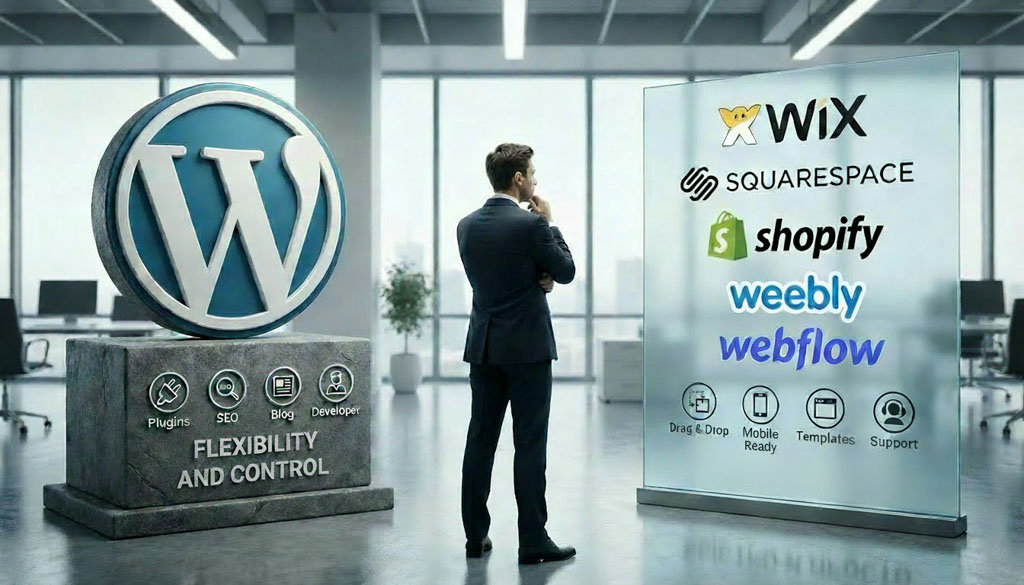
WordPress powers over 40% of all websites globally and remains the top choice for businesses that want full control. It offers thousands of themes and plugins, excellent SEO capabilities, and the ability to scale from a simple five-page site to a full e-commerce store. The downside: you need a developer or solid technical knowledge to maintain it properly.
Website Builders (Wix, Squarespace, Webflow)
For businesses that want something up and running quickly without code, website builders are a strong option. Squarespace excels at visual design, Wix offers the most beginner-friendly editor, and Webflow provides designer-level control with clean code output. The trade-off is less flexibility and ongoing subscription costs.
Custom Development
If your business has complex requirements — booking systems, integrations with accounting software, or a multilingual setup — custom development might be the way forward. Costs are higher, but the result is a website for company needs that fits like a tailored suit rather than off-the-rack clothing.
What a Modern Business Website Must Include
Regardless of your industry, every effective business website needs these core elements:
- Clear value proposition above the fold — visitors should understand what you do within five seconds
- Contact information on every page — phone number, email, and physical address (if applicable) in the header or footer
- Mobile-responsive design — no pinching, zooming, or horizontal scrolling on any device
- Fast loading speed — under 2.5 seconds for the largest content element (LCP)
- SSL certificate — HTTPS is mandatory for trust and search rankings
- Google Analytics and Search Console — you cannot improve what you don’t measure
- SEO-optimized content — proper heading structure, meta descriptions, and keyword-relevant pages
- Social proof — client testimonials, case studies, reviews, or partner logos
- Call-to-action buttons — every page should guide the visitor toward a next step
Skip any of these, and your business website will underperform — no matter how good it looks.
How Much Does a Business Website Cost in 2026?
Pricing varies widely depending on complexity, platform, and who builds it. Here is a realistic breakdown for the Estonian market:
- DIY with a builder (Wix, Squarespace): €10–40/month, plus your time
- Simple WordPress site (5-8 pages, template-based): €500–1,500
- Custom WordPress site (unique design, SEO setup, content): €1,500–5,000
- E-commerce store (WooCommerce or Shopify): €2,000–10,000+
- Ongoing maintenance: €50–200/month for updates, hosting, and security
The cheapest option is not always the best value. A €500 website that doesn’t rank in Google and doesn’t convert visitors is more expensive than a €3,000 site that generates leads every week.

Common Mistakes That Kill Business Websites
After reviewing hundreds of small business websites, these are the errors that come up repeatedly:
- No clear goal — the site exists, but there’s no strategy behind it
- Ignoring mobile users — menus don’t work, buttons are too small, text is unreadable
- Slow hosting — saving €5/month on hosting costs you hundreds in lost visitors
- No SEO from day one — adding SEO later is three times harder than building it in
- Outdated content — a site with 2022 pricing or old team photos damages credibility
- Missing analytics — running a website without analytics is like driving blindfolded
Frequently Asked Questions
Do I really need a business website if I have social media?
Yes. Social media is excellent for visibility, but it doesn’t replace a website. You don’t own your social media audience — the platform does. A business website gives you full control over your message, branding, and customer data.
How long does it take to build a business website?
A simple site with a website builder can launch in a few days. A professional WordPress site typically takes two to six weeks. Custom development projects may require one to three months depending on scope.
Which platform is best for a small business website in 2026?
WordPress offers the best balance of flexibility, SEO performance, and long-term value. Website builders like Squarespace or Wix work well if speed and simplicity are your priority. Your choice should depend on your budget, technical skills, and growth plans.
Can I build a business website myself?
You can, especially with modern builders. However, doing it well requires understanding of SEO, design principles, and user experience. Many business owners start themselves, then hire a professional to polish and optimize the result — that hybrid approach often delivers the best return on investment.
