Service — Web Design & UX · Tallinn & across Estonia
Web design that sells for you
Design isn’t a picture — it’s the customer’s path to an enquiry. We do UX analysis, prototypes and design systems, then build the site ourselves. Design is included: a full website from €590. The cases below are live — including a store whose sales grew fourfold.
Web design for every goal
Good design starts with the question "what for". Collect enquiries from ads, earn a partner’s trust, sell a product — the answer shapes everything: structure, emphasis, even the colour of the button. Below are the four jobs clients bring us most often.
- 01
Website design
A new site from scratch or a refresh of an old one. Clear structure, its own character — and design that walks the visitor to an enquiry, not just "looks nice".
- 02
Landing page design
One page, one goal. A prototype and visuals that turn an ad click into an enquiry. Every screen answers the question "why you".
- 03
Brand & design system
Colours, typography and components gathered into a system. Your website, socials and decks look like one company — not three different ones.
- 04
Corporate site UX
A multilingual site with thought-through journeys: a client, a partner and a job-seeker each find their answer in a couple of clicks. Accessibility is designed in from the first layout.
Design you can open
Everyone promises "modern design" — we’d rather show it. Below are four live projects: each with its own task, its own character and its own result in numbers. Open any of them in the next tab and try it.
-
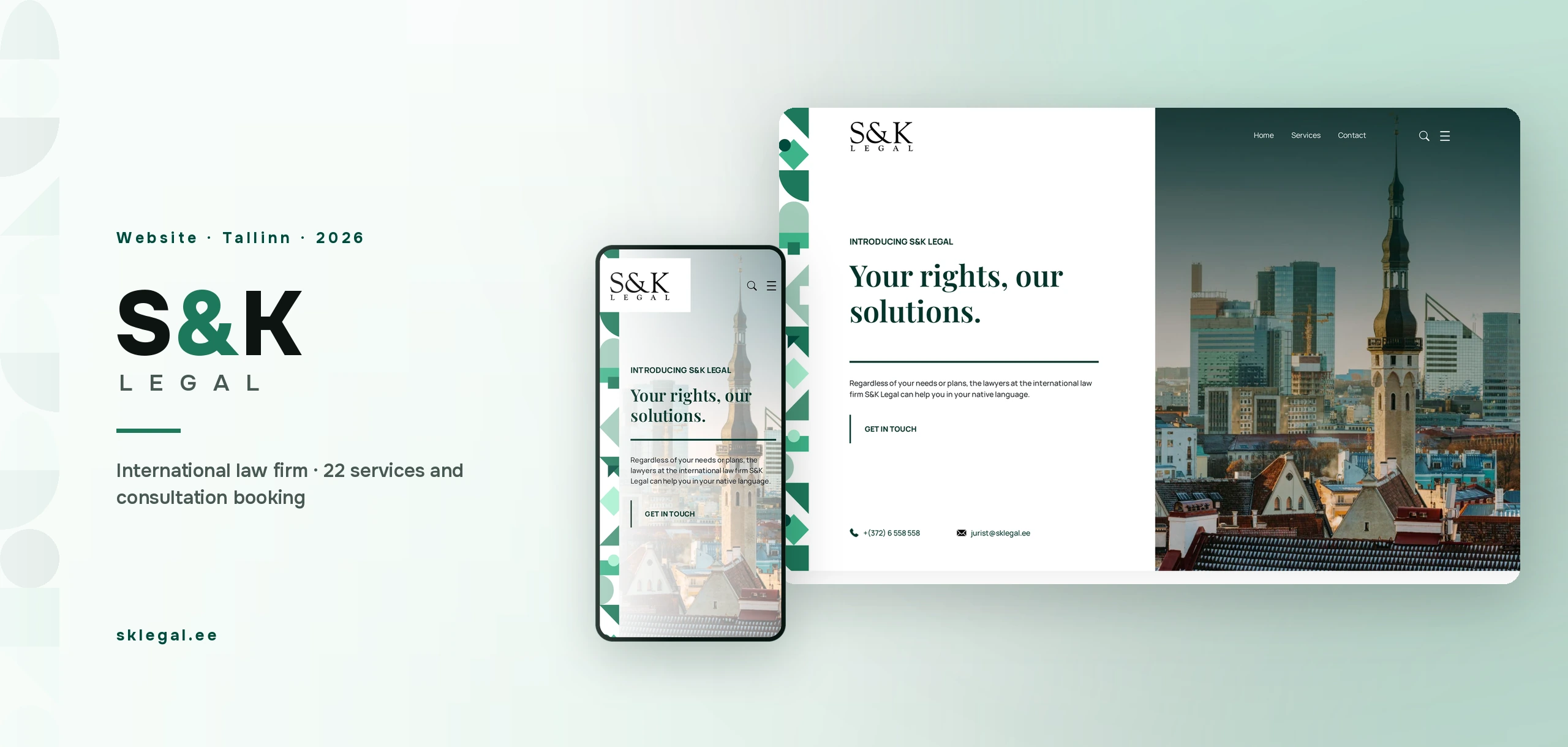 Law firm website · 2026
 S&K Legal
An international law firm in central Tallinn. Strict typography, a calm rhythm — and a structure where 22 services never get lost.
22 service pages -
 Rug e-commerce · 2026
 Softdecor
Premium handmade rugs. We reworked the catalogue, filters and product page — the path to purchase became short and obvious.
×4 sales growth -
 Luxury brand · Iceland
 Eiderdown
Eiderdown is one of the most expensive materials on earth. The design conveys that luxury with silence: air, photography, not one spare element.
1100+ years of tradition -
 Concept store · Nordic
 Flâneri
A Scandinavian eco boutique for Finland and Sweden. Airy layout, clean typography and a friction-free path from product to cart.
3 languages, two markets
That’s only a slice: all 30 projects live in the iweb.ee portfolio — from the Estadesign furniture store to the InCom Profit site with a price calculator.
How much does web design cost
In many studios design is a separate invoice line: first mock-ups for €500–2000, then development for extra money. We keep it simpler: design is included in the website price. Below is the lower bound for three typical projects — UX work, mock-ups and the build together.
- 01
Landing page
from 590 €
Design and build of one page with one goal — ads, a launch, lead capture.
- UX structure and a prototype before visuals
- design built on your brand, not a theme-store template
- responsive layouts: phone, tablet, desktop
- enquiry form and analytics set up
- 02
Corporate website
from 890 €
Design for a company site of up to 6 pages — with a style that lasts for years.
- prototype and design of every key page
- style guide: colours, type, components
- accessibility and speed baked into the layout
- admin panel: you update content yourself
- 03
Online store
from 1090 €
Design of the storefront, catalogue and cart + a working store with payments.
- catalogue and filter UX — products found fast
- a product page that actually sells
- a checkout path without extra steps
- Montonio or Maksekeskus — Estonian bank links
Prices exclude VAT; payment in two parts — a deposit at the start, the rest at handover. Need design only, without development? Also possible — we quote by scope and name the figure before work starts. What drives the price, we broke down in how much a website costs.
Design is more than «looking nice»
-
01 UX analysis & user journeys
We look at the site through your customer’s eyes: why they came, what they seek, where they hesitate. Structure grows from that — not from a designer’s taste.
-
02 Prototype before visuals
First the logic and page skeleton, then the colours. We argue about structure on a wireframe in an hour — not about a finished mock-up for a week.
-
03 Custom UI
Typography, colour, buttons and components — built on your brand. No theme-store templates: you won’t meet your own website at a competitor’s.
-
04 Design system or style guide
Rules and components in one place. A year later you add a page in the same style — without "what was our blue again?".
-
05 Responsive & accessible
Every layout is thought through for phone and desktop. Contrast, touch-target sizes and readability are checked upfront, not after complaints.
-
06 From mock-up to code — no third parties
Design and code are made by one team. The mock-up never flies "over the fence" to a contractor: what is drawn is what ships, to the pixel.
A clear path to great design
Five stages, and at each one you see the result before we move on. We argue about structure on a prototype, not on a finished mock-up — so changes are cheap and the end holds no surprises.
-
UX analysis & goals
We dig into your audience, competitors and goals. We agree upfront what the design must do: enquiries, sales, trust.
-
Structure & prototype
Page skeletons and content hierarchy — wireframes without colour. We approve the logic while it is still cheap to change.
-
Visual design
Typography, colour, components, states. Every screen in mobile and desktop versions, in one consistent brand style.
-
Design system & build
We gather components into a system and move the design into code. Development happens in-house — nothing gets lost on the way.
-
Testing & polish
We check usability, speed and accessibility on real devices. Details get refined until the experience sits right.
These five steps scale with the project: for a landing page they compress into about a week, a corporate site takes one to two, a store two to three. With development: a landing page in 1–2 weeks, a website in 2–4, a store in 4–6. The fastest projects are the ones where decisions aren’t made by a committee of seven.
How it works and how it looks
On the first call we’re often asked how UX differs from UI. The short answer: UX is how the site works, UI is how it looks. The long one is below. What matters: they don’t work apart, so we never separate them.
- User experience
UX — how the site works
Structure, journeys and logic. UX answers the questions: does a visitor understand within five seconds where they landed? Do they find the price? Do they reach the form? Good UX is invisible — everything simply works first time.
What we do
- journey maps and page structure
- prototypes and the path to enquiry
- tests with real people
- User interface
UI — how the site looks
Typography, colour, buttons, cards, motion. UI makes the first impression: "a serious company" or "knocked together". We draw the UI around your brand — and build it into a system so the style holds for years.
What we do
- a visual language built on your brand
- components and their states
- a design system for growth
The third layer is the design system: components and rules that hold UX and UI together as the site grows. When the system extends to the logo and corporate identity — that’s branding, and we do that too.
When your site is due a redesign
A redesign isn’t "repainting the buttons". It’s the moment to fix what stops the site from selling: structure, speed, the mobile experience. Four signs the time has come:
-
01 The site looks five years older than the company
The business grew, the website stayed behind. Clients compare you with competitors one browser tab at a time — losing that shop window is expensive.
-
02 Visitors come, enquiries don’t
Ads bring people, but they leave without acting. Usually it is not "bad traffic" — it is UX: the price wasn’t found, the form wasn’t trusted, the button hid.
-
03 It’s awkward on a phone
Most visits come from mobile. If the menu is tiny, text overflows and buttons don’t respond to a thumb — you are losing more than half your guests.
-
04 Updating the site feels risky
Every edit breaks the layout, new pages look foreign. That means there is no system — a redesign puts things in order once and for a long time.
A common fear: "after the redesign we’ll vanish from Google". Done carefully, it doesn’t happen: we keep addresses and metadata, set up redirects, and the speed gain usually helps rankings. Visibility after launch is the job of SEO services, and website maintenance keeps the site in shape.
Design that pays off
There are plenty of beautiful portfolios. So below are not adjectives but things you can verify: case numbers, speed you can measure, and 30 projects with client names in the open portfolio.
-
01 Design for results
Beauty is a tool, not the goal. After the Softdecor store redesign, sales grew fourfold — that’s the kind of design we call successful.
-
02 UX before visuals
Structure and journeys first, colours second. That way a beautiful wrapper never lands on a page where nobody can find the button.
-
03 Design and code in one place
Mock-ups never fly "over the fence" to a contractor. One team designs and builds — the design reaches the browser exactly as drawn.
-
04 Three languages, one system
We design in Estonian, English and Russian at once. Texts of different lengths never break the layout — it’s accounted for from screen one.
-
05 Speed is built into the design
A beautiful page that loads in three seconds loses customers. Google’s speed metrics (Core Web Vitals) are on our mind at the mock-up stage: the first screen opens in under a second.
-
06 12+ years of experience
30 projects in the open portfolio — Estonia, Finland, Iceland, Germany. We know what design earns trust on this market, and what is merely fashionable.
Designed in Estonia, delivered anywhere
Our office is in Peetri, just outside Tallinn, but geography is no barrier for design: we discuss prototypes over video as concretely as across a table. What actually matters is knowing the market you’re selling to — and for companies registered in Estonia, that market is ours.
-
Remote by design
Brief, prototypes and sign-off all happen online. Contracts are signed with Smart-ID or an EU digital signature — many clients we have never met in person, and it has never been a problem.
-
Design for the Estonian market
We know what "trustworthy" looks like to a local buyer: language switcher done right, Estonian bank links at checkout, familiar delivery options in the cart.
-
Three languages as standard
Estonian, English and Russian designed in one system from day one — different text lengths never break the layout. Finnish on request.
-
EU paperwork, no surprises
Contract, invoice and VAT are handled under EU rules. For e-Residency companies we are a local partner: same time zone, same regulations, same market.
Running an Estonian company from abroad? We wrote a practical guide: a website for an e-Residency company.
You ask, we ans
The questions we hear most often on a first call. If yours isn’t here — write to us and we’ll answer like humans: no "it depends on many factors", no invoice for the consultation.
How much does web design cost in Estonia?
On the market, landing page mock-ups alone go for €500–2000, and corporate site design for up to €5000. With us, design is included in the website price: a landing page from €590, a corporate website from €890, an online store from €1090 — development included. There is no separate "design" line in the invoice. You get an exact figure within one business day.
What does web design include?
UX analysis, structure and a prototype, visual design of every key page, responsive versions for phone and desktop, and a style guide or design system. Then we move the design into code ourselves — the mock-up never stays a picture.
What is the difference between UX and UI design?
UX is how the site works: structure, journeys, the path to an enquiry. UI is how it looks: type, colour, buttons. They don’t live without each other: a beautiful site with confusing logic loses customers, a usable but sloppy one loses trust. We do both together.
Custom design or a template — which should I choose?
A template is faster and cheaper, but it looks like a thousand other sites and bends with difficulty. Custom design starts from your brand and audience — you stand out, and every element works towards the goal. Honestly: if the budget is very tight and speed matters more than standing out, we will say so.
Can I order design only, without development?
Yes. We will do the UX analysis, prototype and mock-ups and hand them to your team — with tidy source files and notes. But our strongest argument is design and code from one place: nothing gets lost between the mock-up and the browser.
Do you redesign existing websites?
Yes, it is a substantial part of our work. We start with a UX audit: we show where visitors get stuck and why they leave. Often targeted fixes to structure and interface are enough — a full rebuild isn’t always needed, and we don’t sell one "just in case".
Will a redesign hurt my Google rankings?
Done carefully — no. We keep page addresses, metadata and internal links, and set up redirects where the structure changes. Speed and the mobile experience usually improve after a redesign — and rankings with them.
What is a design system and do I need one?
A set of components and rules: colours, type, buttons, cards. It keeps the site consistent and makes every next page faster and cheaper. A small site is fine with a style guide; for a growing company a system saves real money.
Is the design responsive from the start?
Yes. Every screen is designed for phone, tablet and desktop — most visitors arrive on mobile. We often start with the mobile view: if the journey works on a small screen, it will certainly work on a big one.
What do you design in, and do I get the source files?
Our working tool is Figma. After handover the sources are yours: files, components and the style guide. Nothing ties you to us — though most clients stay, because it’s convenient.
How long does design take?
Landing page design — about a week; a corporate site — one to two; a store — two to three. With development: a landing page in 1–2 weeks, a website in 2–4, a store in 4–6. The main factor is feedback speed: the faster stages are approved, the closer the deadline sits to the lower bound.
Does the design work in three languages?
Yes, we design multilingual from day one: Estonian, English and Russian, Finnish if needed. It shapes the layout from the first screen — texts of different lengths, a language switcher, language markup for Google. One system keeps all versions consistent.
How do we start?
Write to info@iweb.ee or fill in the form at the bottom of the page — a couple of sentences about the task is enough. Within one business day we come back with questions and a proposal: scope, deadline and price are fixed in it.
Get clarity before you order
-
Web design trends 2026
What will actually stick from the fashionable — and what already looks dated.
-
How much does a website cost in 2026
What makes up the price of a website and where not to cut corners.
-
AI website builders vs a web studio
What Lovable, v0 and Framer can do in 2026 — and where the gap remains.
-
What is a landing page and how does it sell
When a single page works better than a full website.
-
A website for an e-Residency company
How to launch an Estonian web presence from anywhere in the world.
-
How to start an online store in Estonia
Payments, delivery and design — what an e-commerce project is made of.
Related services: website development, branding, e-commerce development and Google Ads — when the design also needs traffic. Who we are — briefly on the studio page.
Let’s see what your site could be
Describe the project in a couple of sentences — that’s enough. Within one business day we reply with a clear estimate: scope, deadline and price.
info@iweb.ee